Source: Reuters
Rabia Akhtar
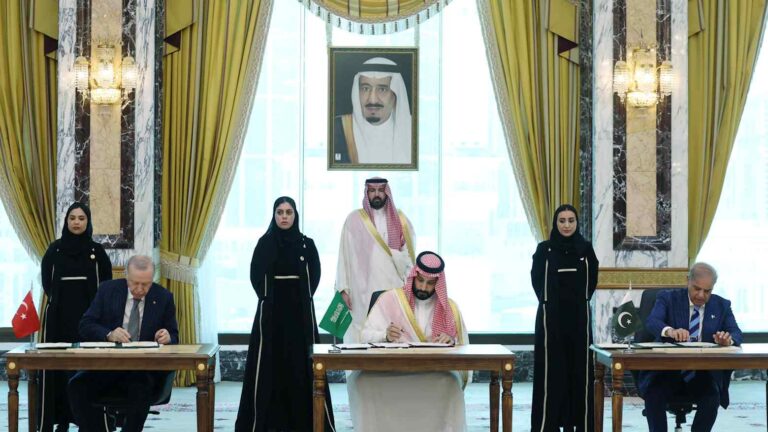
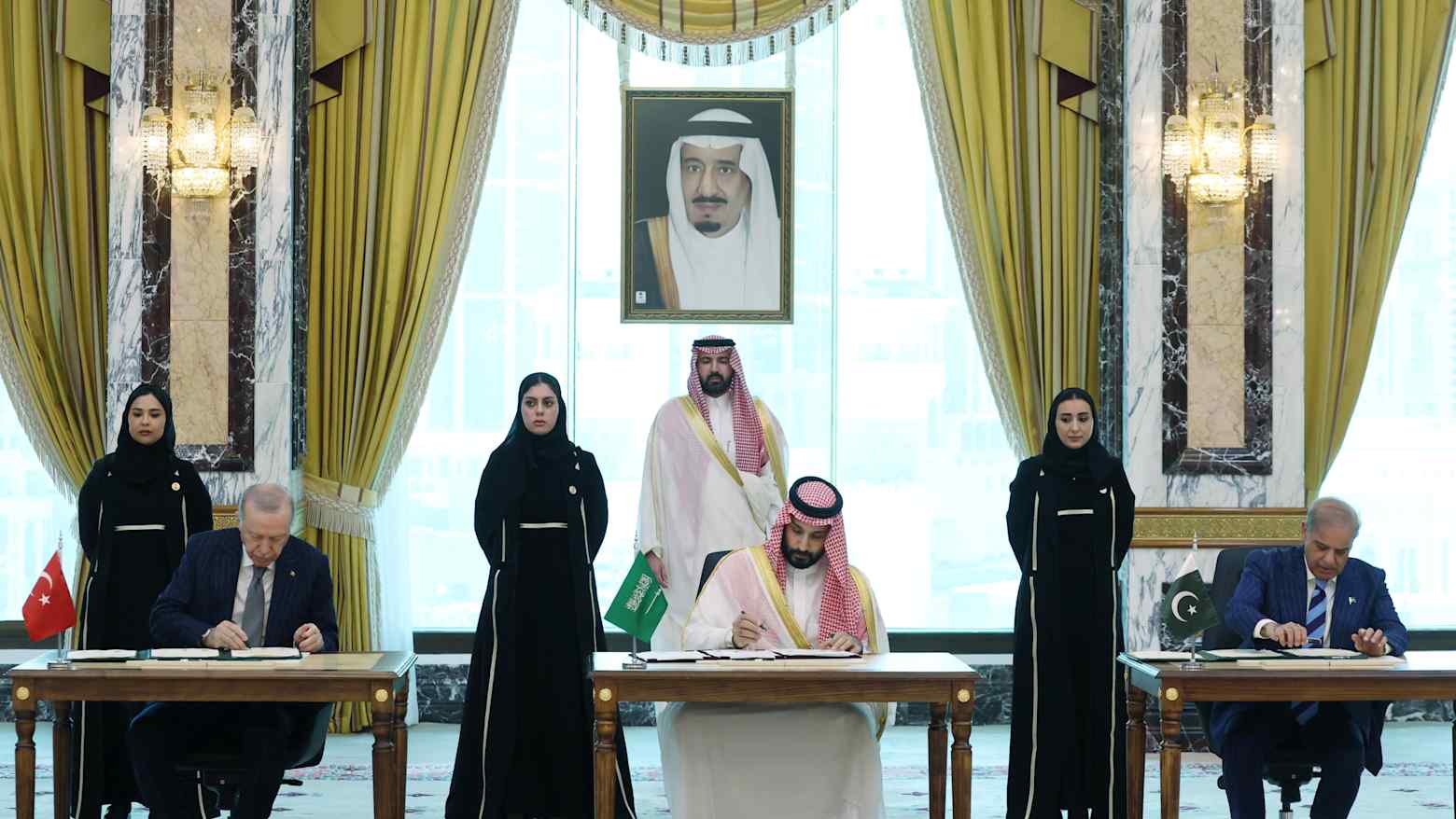
The Makkah Joint Defence Agreement is a new trilateral mutual-defense pact signed on 7 August 2026 (24 Safar 1448H) in Makkah, Saudi Arabia, by Saudi Crown Prince Mohammed bin Salman, Turkish President Recep Tayyip Erdoğan, and Pakistani Prime Minister Shehbaz Sharif.
There is something important about the fact that this agreement was signed in Makkah and I do not mean that simply in the vocabulary of Islamic solidarity. The symbolism is subtler than that.
Makkah gives the agreement political geography beyond the three capitals signing it. It places the compact in a space that belongs, symbolically, to a much wider community. That matters particularly because the agreement has simultaneously been described as defensive, not directed against any particular state, and open to other brotherly countries seeking regional peace, prosperity and stability. Türkiye has also stressed that the pact does not displace the signatories’ existing bilateral or multilateral commitments.
That last part may eventually prove more consequential than the much-discussed “attack on one is an attack on all” clause. Because what Saudi Arabia, Pakistan and Türkiye may be building is not another NATO. They may be experimenting with something much more suited to the emerging international order: an expandable middle-power security compact. That distinction matters.
NATO emerged from a bipolar world. Its logic was relatively clear: defined adversary, defined geography, integrated command structures, alliance discipline and an external superpower underwriting the system.
The emerging world is different. Middle powers increasingly want security relationships without surrendering strategic autonomy. They want partners without patrons, interoperability without complete alignment, and additional security options without having to abandon existing ones.
Viewed from that perspective, the Makkah Agreement looks less like bloc formation and more like strategic portfolio diversification. Saudi Arabia does not have to abandon Washington. Türkiye does not have to leave NATO. Pakistan does not have to alter its relationships with China, the Gulf, the United States or other partners.
And that is precisely the point.
For decades we tended to imagine security architecture as a series of concentric alliances: countries chose camps and security flowed vertically from great powers towards smaller states. What we increasingly see instead is horizontal security networking among capable regional states themselves. Makkah may represent one such node.
And the three countries are interesting precisely because they are not interchangeable.
Saudi Arabia brings capital, energy weight, political influence and extraordinary strategic geography connecting the Gulf, Red Sea and wider Arab space.
Türkiye brings one of the Muslim world’s most developed defence-industrial ecosystems, significant conventional military capacity, NATO interoperability and operational experience across multiple theaters.
Pakistan brings a large professional military, decades of defence cooperation with both states, experience operating under conditions of severe conventional and strategic deterrence, access to the Arabian Sea and Indian Ocean and, inevitably, the political weight that comes from being a nuclear-armed state.
But I would be extremely careful about converting that final fact into claims about a Pakistani “nuclear umbrella.” The agreement does not publicly say that. Pakistan’s nuclear deterrent has historically been constructed around its own national security requirements, and we should not invent extended-deterrence commitments where none have been announced.
The real power of the grouping may lie elsewhere. It is what can be called asymmetric complementarity. None of the three needs to replicate the capabilities of the other two. Capital can meet defence-industrial capacity. Defence-industrial capacity can meet operational military experience. Military capacity can meet strategic geography. Intelligence, air and missile defence, maritime security, drones, electronic warfare, training, logistics, defence production and emerging technologies all become areas where pooled capability can produce more than the sum of its parts.
And there is another feature that deserves much more attention. Türkiye belongs to NATO. Saudi Arabia sits at the center of Gulf and Arab security politics. Pakistan belongs strategically to South Asia while also being deeply connected to China, the Gulf and the wider Indian Ocean.
The three therefore sit inside different security ecosystems. Their cooperation potentially creates bridges between architectures rather than another architecture designed to replace them.
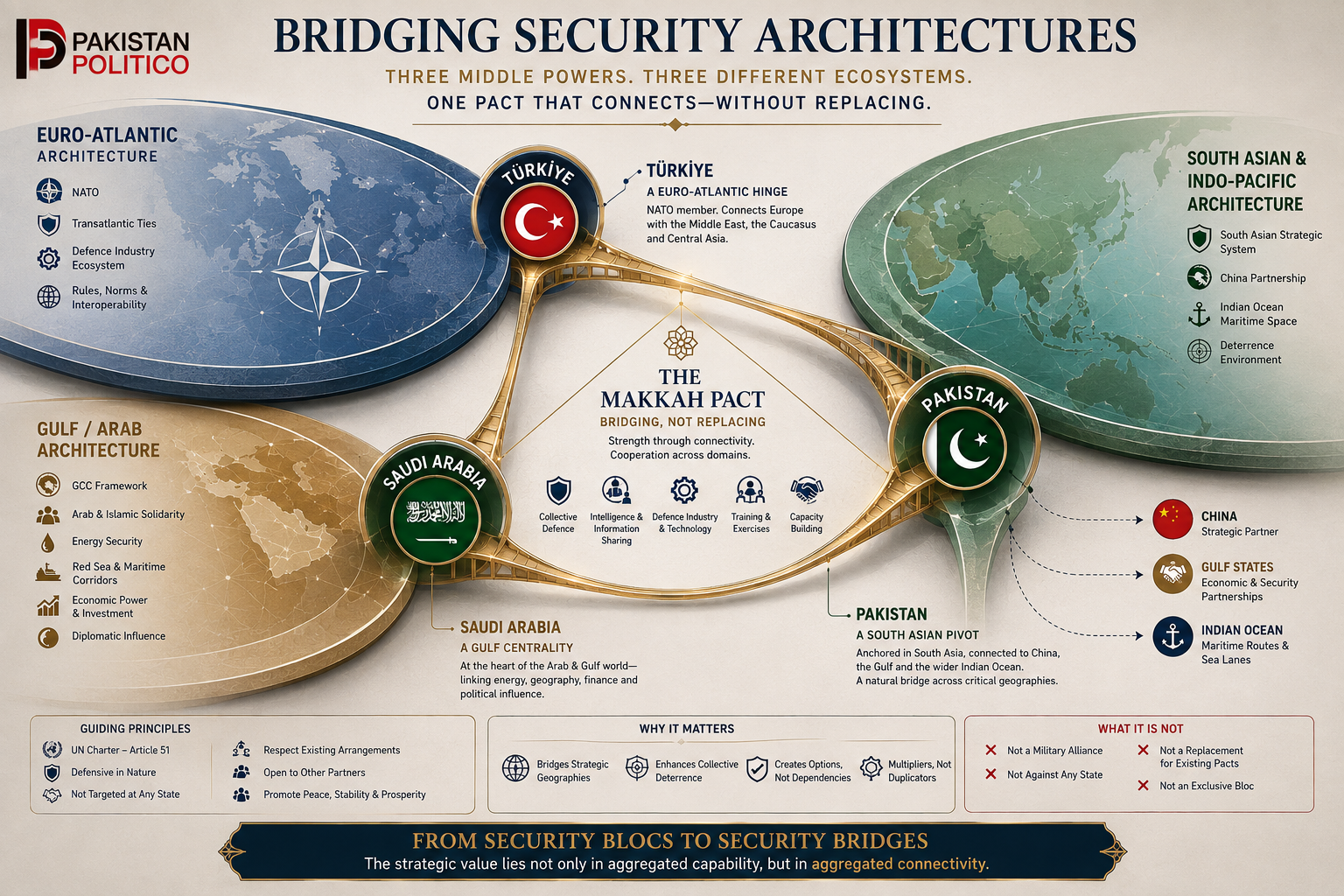
That is quite different from an “Islamic NATO.” In fact, calling it Islamic NATO may obscure the most interesting thing happening. This may be an attempt to build security in layers.
American partnerships remain one layer. NATO remains another. The GCC another. Bilateral strategic relationships another. And increasingly, flexible coalitions among regional middle powers form an additional layer.
Security diversification therefore does not necessarily mean decoupling from the United States or anybody else. It can simply mean refusing to allow one relationship to carry the entire burden of national security. That is what sophisticated states do with financial portfolios. Increasingly, they are doing it with strategic portfolios too.
Which brings me to perhaps the most interesting phrase associated with the agreement: openness to others as stated by the Turkish President Erdoğan. If that principle survives implementation, the Makkah framework could eventually become less an alliance than a platform. And platforms behave differently from alliances. Membership need not immediately require ideological conformity. Cooperation can be modular. A country might participate deeply in maritime security, another in air defence, another in counterterrorism, another in defence production. The architecture can grow functionally before it grows institutionally.
That also gives the founders an opportunity to prevent this from becoming a Sunni bloc, an anti-Iran coalition or an anti-anybody coalition.
The smartest version of this architecture would define itself around public goods, freedom of navigation, protection of critical infrastructure, counterterrorism, defence-industrial resilience, missile and drone defence, intelligence cooperation and crisis management, rather than around enemies. That distinction will ultimately determine whether the Makkah Agreement stabilises the region or merely adds another line of division to it.
And perhaps that is why Makkah is such an interesting place from which to begin. Its greatest symbolism may not be that three Muslim states came together there. It may be that three increasingly consequential middle powers chose Makkah to say that regional states themselves intend to have a greater hand in designing the security order around them.
For much of the post-Cold War period, Middle Eastern and South Asian security architectures were largely discussed in Washington, London, Moscow or, increasingly, Beijing.
Perhaps the deeper message from Makkah is simply this: the consumers of security increasingly want to become its producers.
That is a much bigger geopolitical story than an “Islamic NATO.”
Prof. Dr. Rabia Akhtar is Editor Pakistan Politico. She tweets @Rabs_AA.
About the Author