Iraj Abid
Throughout history, technological advances have redefined how wars are fought and won. Today’s battlefields are witnessing a transformation, as evidenced by recent conflicts in Ukraine and the Middle East, where low-cost systems such as drones are producing effects that previously required far more expensive platforms. Globally, unmanned systems are emerging as force multipliers with disruptive effects and asymmetric cost benefits. In the U.S.-Iran conflict, for instance, the U.S. spent up to USD 1-4 million on an interceptor missile to take on an Iranian Shahed-136 kamikaze drone that costs around USD 20K-50K.
As militaries race to integrate emerging and disruptive technologies (EDTs), including artificial intelligence (AI), drones, electronic warfare, and cyber capabilities, into their strategies, military advantage is becoming a function of data-driven operations, networked systems, autonomous capabilities and rapid innovation, rather than expensive legacy platforms.
In this tech-driven strategic environment, both challenges and opportunities abound for Pakistan. Islamabad faces an existential threat from India, which enjoys a numerical advantage in terms of men, money, and military hardware. In 2025, New Delhi’s military expenditure (USD 92.1 billion) was nearly eight times more than Pakistan’s (USD 11.9 billion). India also receives latest weapon platforms and technology from Western countries by positioning itself as a counterweight to China. Leveraging these partnerships, India has modernized both conventional and nuclear forces and dual-capable long-range delivery systems in South Asia. India has also deployed 12 nuclear warheads.
All these factors contribute to an increasingly belligerent posture by New Delhi. India attacked nuclear-armed Pakistan twice in the past seven years, only to be thwarted by decisive retaliations.
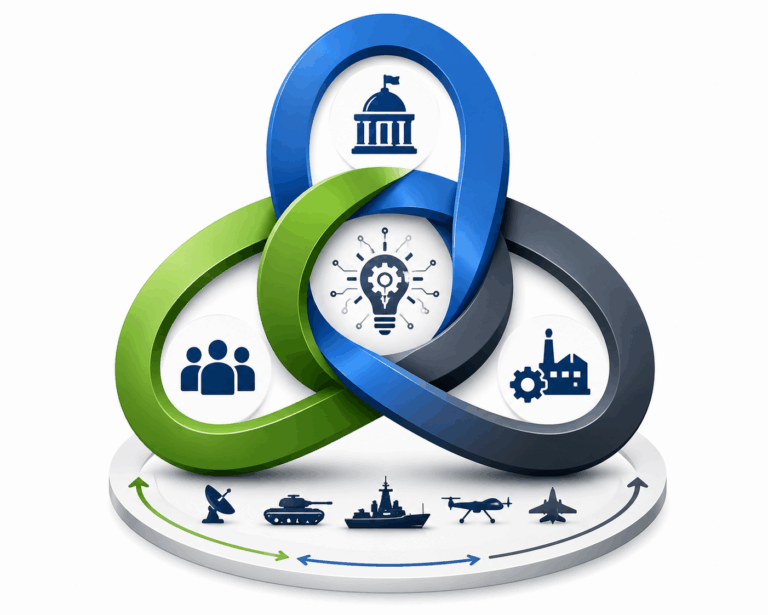
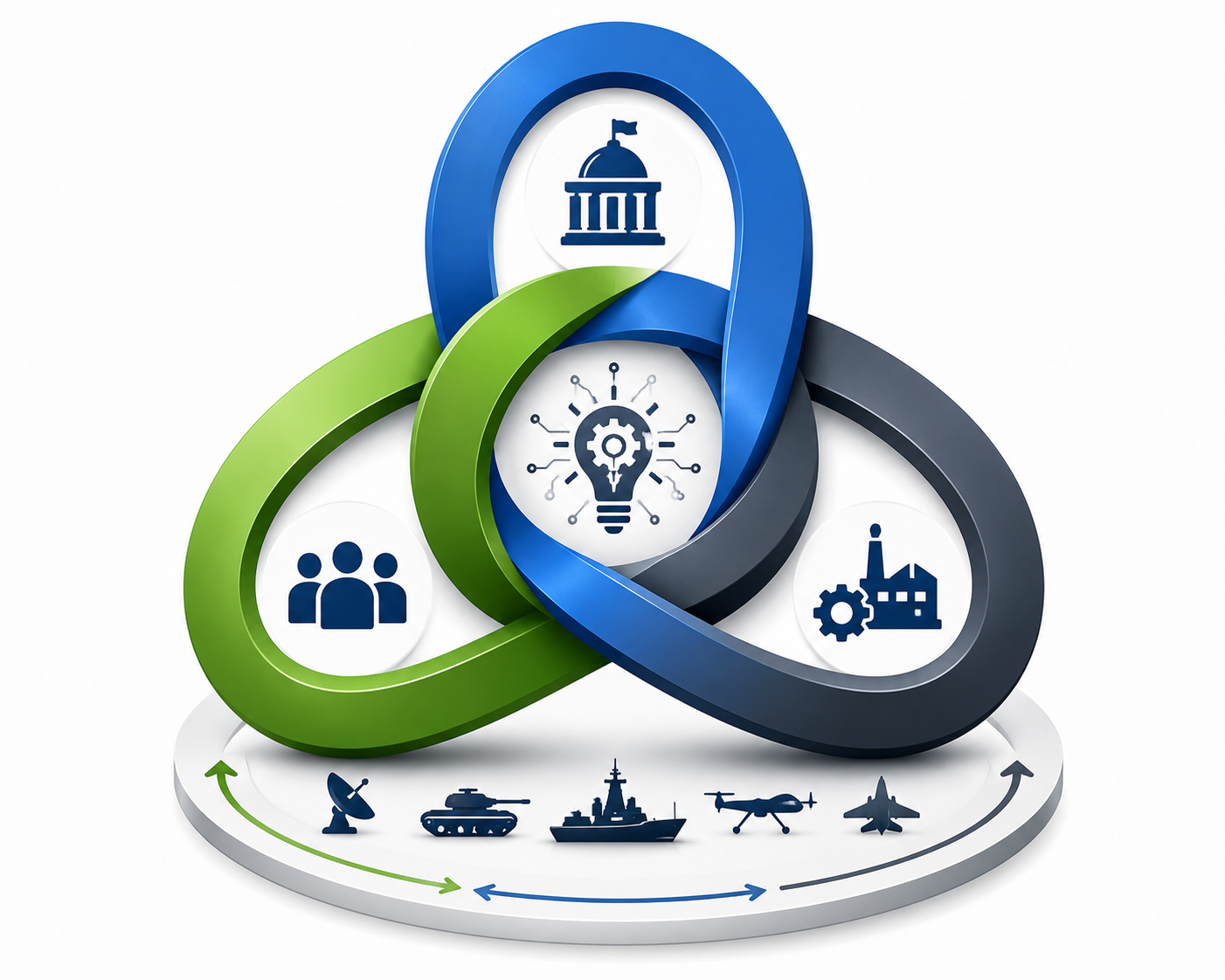
Faced with a hostile neighbor and an uncertain regional and international security environment, Pakistan is left with no choice but to further strengthen its domestic defense-technology ecosystem through sustained innovation. This can be achieved by institutionalising a Triple Helix Model that systematically connects academia, industry, and the government to develop and deploy defense technologies.
The Triple Helix Model rests on a simple premise: sustained innovation emerges when academia, industry, and government operate as a unified system. This includes: (i) universities generating knowledge and cultivating talent; (ii) industries transforming research into commercially viable products; and (iii) the state, including the military, defining operational requirements, funding projects, and providing a real-world testing ground.
The Triple Helix Model has been successfully applied in numerous defense innovation ecosystems. The US Defence Advanced Research Projects Agency (DARPA) is considered a global standard in defense innovation. It funds high-risk, high-reward research, and its project-driven model links universities and the private sector to the Pentagon. As a result, DARPA facilitated the development of technologies including GPS, stealth systems, autonomous platforms and ARPANET, the precursor to the Internet.
In China, leading tech firms such as Huawei, Alibaba, and Baidu collaborate with the defense industry in areas including advanced communications, AI, data analytics, and autonomous systems.
Navigating Western sanctions and technology restrictions, Türkiye becomes an ideal example for Pakistan. Until 2002, Ankara imported around 80% of its military equipment. Today, over 35 countries buy its Bayraktar TB2 drones and Unmanned Combat Aerial Vehicles (UCAVs). Türkiye’s indigenous naval platforms are world-class, whereas a fifth-generation fighter aircraft program is under development. This shift in the defense sector is the result of continued political commitment along with an increase in research and development (R&D) spending, which rose from 0.46% of GDP in 2000 to 1.46% in 2024. Practically, the Triple Helix Model was applied to establish the domestic defense industrial base. Turkish universities established specialized engineering clusters and technology parks. Firms such as ASELSAN and Baykar converted research into deployable military systems, and the government provided both funding and guaranteed procurement.
Fortunately, Pakistan already has the foundational base for the Triple Helix Model. The NED University of Engineering and Technology, National University of Sciences and Technology (NUST), Pakistan Institute of Engineering and Applied Sciences (PIEAS), Ghulam Ishaq Khan Institute of Engineering Sciences and Technology (GIK Institute) and University of Engineering and Technology (UET) Lahore have shown capabilities in engineering, robotics, computer sciences and AI. According to the QS World University Rankings 2027, PIEAS improved from 721-730 band in 2026 to 560 in 2027, an improvement of 160 positions. Initiatives such as the National Aerospace Science and Technology Park (NASTP) are providing avenues for collaboration among academia, startups and industry.
A fast-growing IT sector shows Pakistan’s strong potential in AI, cybersecurity, and big data. In FY2023-24, IT exports reached a record USD 3.2 billion, complemented by a skilled workforce employed by global firms.
Pakistan has a thriving defense industry. This is evidenced by the co-production of JF-17 Thunder aircraft by the Pakistan Aeronautical Complex (PAC), its sales to multiple countries, the production of Al-Khalid tanks by Heavy Industries Taxila (HIT), building of indigenous naval platforms by Karachi Shipyard and Engineering Works (KS&EW), and an indigenous UAV program that has produced Burraq and Shahpar drones. All of this demonstrates growing Intelligence, Surveillance and Reconnaissance (ISR) and precision-strike capabilities.
Despite strengths, the defense industrial base suffers from a few systemic challenges. Pakistan allocates only about 0.16%–0.25% of its GDP to R&D. This is insufficient for innovative research. The limited funding makes it impossible to have advanced prototypes where the functioning of new systems can be tested and further improved. Brain drain is another pressing issue as every year, thousands of engineers and technology professionals leave the country in search of better opportunities. For a robust tech ecosystem, retention of human resource is essential.
To realize the defense-tech potential, a coherent national strategy is required to strengthen linkages among academia, industry, and the military. Increasing the R&D budget could provide a much-needed impetus to innovation. Defense and industrial sectors could jointly sponsor high-risk and high-impact research in universities, especially in the field of emerging technologies. A nationwide defense innovation network could be created by connecting existing technology parks to universities, startups, private industry, and military research organizations. Indigenous production should be prioritized in procurement policy. Private industry could be encouraged and incentivized for greater participation in the defense sector.
A concrete step forward could be the establishment of a Defense Tech City—a single cluster of universities, startups, defence industry, military testing facilities and dedicated funding—with a view to promoting synergetic production on a national scale.
The acceleration of defense innovation requires a whole-of-nation approach. In this regard, the Triple Helix Model provides a tested solution for research, development, and deployment of new technologies.
Iraj Abid is a Research Officer at the Center for International Strategic Studies Sindh.
The views expressed in this article are the author’s own, and they do not necessarily represent those of Pakistan Politico.
About the Author