Rabia Akhtar
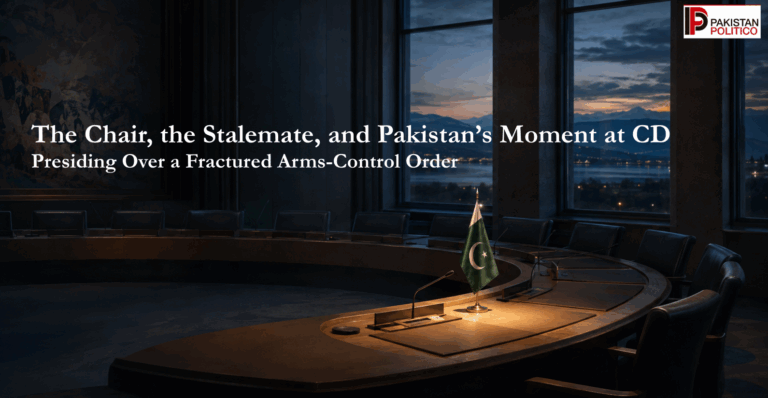
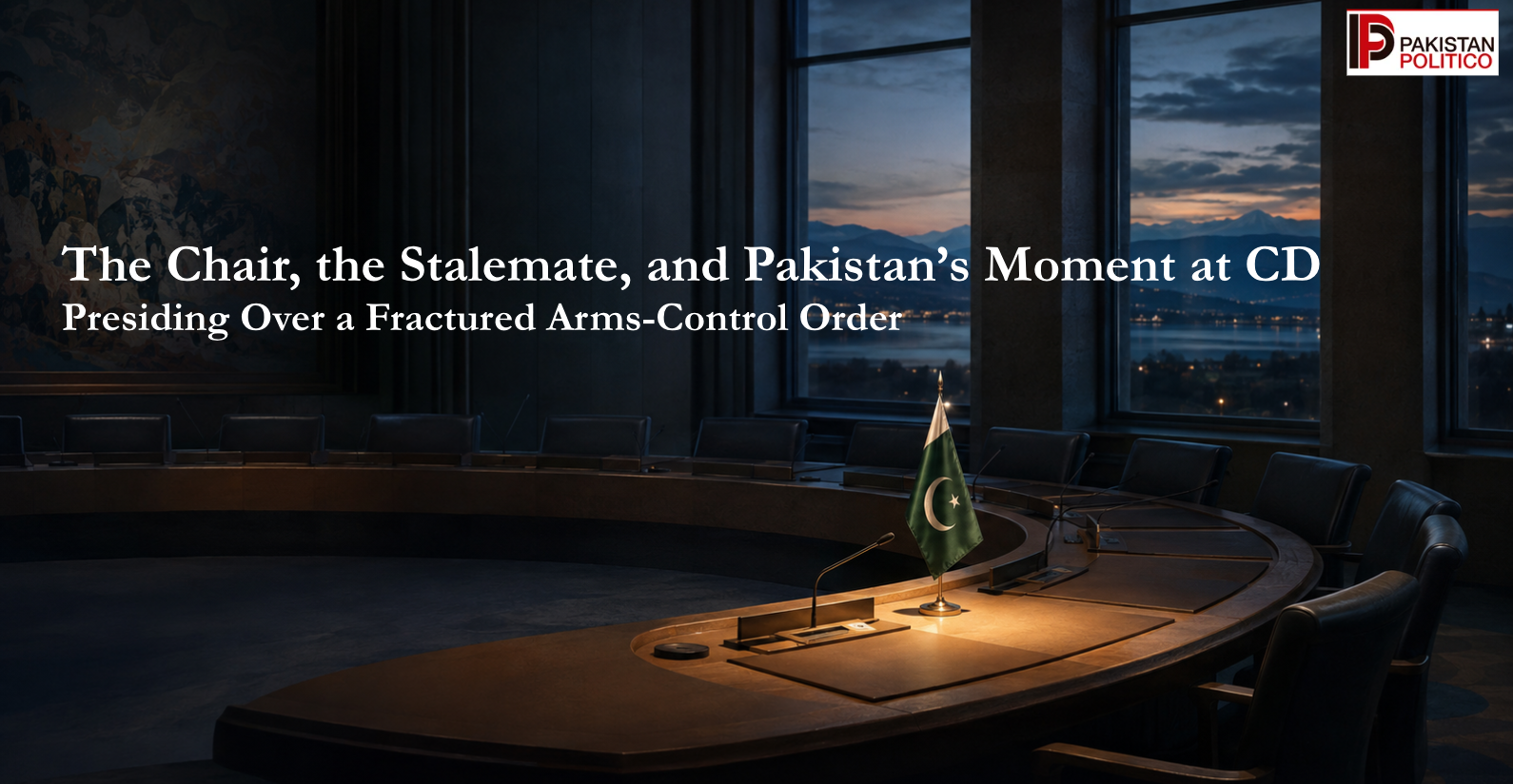
At a moment when arms control is fraying, Pakistan has assumed the Presidency of the United Nations Conference on Disarmament, the forum where the world’s most consequential security questions still converge: nuclear risk, fissile materials, outer space, emerging technologies and the future of strategic restraint.
Pakistan’s presidency is being led by Ambassador Tahir Hussain Andrabi, Additional Secretary for Arms Control and Disarmament and spokesperson for the Ministry of Foreign Affairs. In assuming the chair, he brings to Geneva a distinctly Pakistani arms-control perspective, one shaped by the conviction that durable restraint must rest on equity, non-discrimination and the equal security of all states. For four weeks, Pakistan presides over the only multilateral negotiating forum that brings together all major nuclear-armed states, including the United States, Russia, China, India, Israel and North Korea. As the final President of the Conference’s 2026 session, Pakistan will guide the consultations that conclude the year’s proceedings and steer the Conference’s annual report towards the UN General Assembly.
This is an important diplomatic moment for Pakistan not because the presidency confers unilateral power, but because it places Pakistan at the center of a conversation from which South Asian security concerns are too often treated as peripheral.
The Conference on Disarmament is not merely another UN body. Its predecessor institutions produced the Nuclear Non-Proliferation Treaty, the Biological Weapons Convention, the Chemical Weapons Convention and the Comprehensive Nuclear-Test-Ban Treaty. Its agenda remains unusually relevant to the anxieties of our age: the cessation of the nuclear arms race, prevention of nuclear war, prevention of an arms race in outer space, legally binding security assurances, new weapons of mass destruction and transparency in armaments.
Yet it is also an institution in distress.
The Conference has not negotiated a major treaty since the CTBT in 1996. Its members have repeatedly failed to begin substantive negotiations on a fissile-material treaty. Its consensus rule, essentially requiring all 65 members to agree before the institution can move, has become synonymous with paralysis.
But the deadlock should not be misunderstood as evidence that the Conference is irrelevant. It is evidence that the political conditions for arms control have deteriorated. Institutions do not create strategic trust where none exists. They can, however, preserve the diplomatic space in which trust may one day be rebuilt.
That is why Pakistan’s presidency matters.
Pakistan enters this role as a nuclear-weapon state outside the NPT, but as a full member of the Conference on Disarmament. This matters more than it may initially appear. The wider nuclear order remains structured around a distinction between the five states recognized as nuclear-weapon states under the NPT and everyone else. Pakistan is routinely discussed through the language of exception, challenge or regional instability. In Geneva, however, Pakistan participates as a member in the world’s principal negotiating forum for arms control and disarmament on equal procedural footing with the established nuclear powers.
For Pakistan, this is not a symbolic technicality. It is a reminder that the future of the nuclear order cannot be constructed by ignoring the security realities of states outside its traditional centers of power.
South Asia is not an exception to the global nuclear order; it is one of its clearest tests.
The region brings together conventional military asymmetry, unresolved political disputes, nuclear deterrence, missile competition, growing technological integration and recurring crises. The issues debated in Geneva, fissile materials, missile defence, space security, artificial intelligence, nuclear risk reduction and strategic stability, are not abstract questions for Pakistan. They are part of the strategic environment in which we live.
Pakistan has consistently argued that arms control cannot endure if it is built on selective restraint and unequal security. A credible fissile-material treaty, for example, cannot simply freeze existing asymmetries and call the result disarmament. It must be non-discriminatory, verifiable, and attentive to both future production and existing stockpiles. Similarly, global disarmament cannot become a language used to discipline some states while others modernize their arsenals, acquire strategic exceptions, or pursue military capabilities that alter regional deterrence equations.
This is not an argument against arms control. It is an argument for arms control that is serious enough to last. Pakistan’s long-standing emphasis on equal and undiminished security is often treated as a negotiating position. It is more than that. It is a basic test of whether the international community is prepared to address why states seek security in the first place.
Arms control succeeds when it lowers insecurity; it fails when it merely redistributes vulnerability. The presidency offers Pakistan an opportunity to articulate this case in a broader and more constructive register.
This should not be a moment of bilateral point-scoring with India. Pakistan’s strongest case is not that South Asia deserves exceptional treatment. It is that South Asian stability and global arms control are inseparable. Any conversation about nuclear restraint that overlooks conventional asymmetry, missile defence, counter-force pressures, crises below the nuclear threshold, or the impact of emerging technologies will remain incomplete.
The same is true of the Conference’s future agenda. Artificial intelligence is increasingly shaping intelligence assessment, surveillance, targeting, military planning and decision-support. Space-based assets have become integral to both civilian life and military operations. Cyber capabilities, missile defence, autonomous weapons and counter-space systems are altering deterrence calculations faster than international rules can adapt.
Pakistan has every reason to insist that these developments be discussed through the lens of strategic stability, rather than technological prestige or the pursuit of absolute security by a few powerful states. No state can make itself permanently secure by creating greater insecurity for others.
There is also a broader diplomatic significance to this moment. Pakistan’s assumption of the chair demonstrates the depth of its institutional engagement with multilateral arms-control diplomacy. It allows Pakistan to convene, consult and guide a conversation involving states with profoundly competing interests. The role is not about commanding the room; it is about ensuring that the room continues to function when consensus is elusive.
That task should not be trivialized.
The immediate measure of success will be practical: whether Pakistan can conduct inclusive consultations, prevent procedural breakdown, build sufficient common ground for an agreed annual report, and leave behind a foundation for continuity into the next session. Four weeks cannot resolve decades of division. Nor can any single presidency produce agreements that major powers themselves are unwilling to make.
But diplomacy is not only measured by breakthrough treaties. It is also measured by whether channels of communication are preserved, whether the language of restraint remains available, and whether states that disagree fundamentally can still sit across the table from one another.
For Pakistan, the presidency is an opportunity to show that it is not simply a subject of global nuclear debate; it is a participant in shaping it. It is an opportunity to bring South Asian realities into the heart of international arms-control discussions, to make the case for non-discrimination and equal security, and to reaffirm that strategic stability cannot be built through exclusion.
The Conference on Disarmament may be stalled. But in a world moving steadily towards greater nuclear competition, weaker arms-control restraints and more dangerous technologies, the table still matters.
Pakistan now holds the chair.
Prof. Dr. Rabia Akhtar is editor Pakistan Politico.
About the Author