
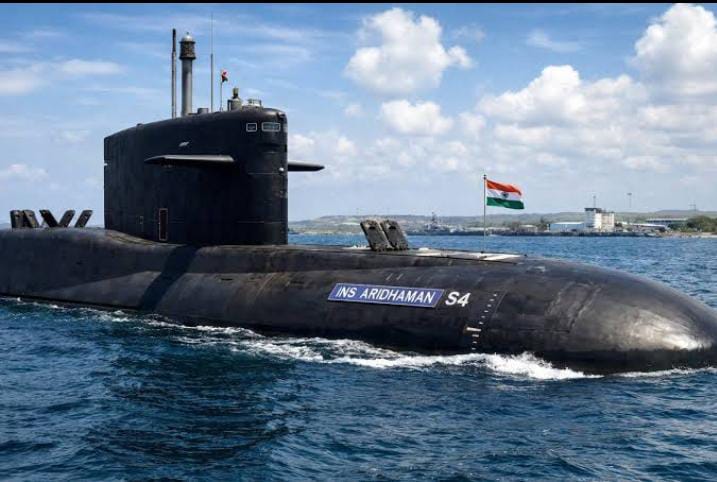
Source: The Strategist
Arbaz Mehmood
India has historically operated under high levels of official opacity, reflecting the need to maintain operational security of its submarine-based nuclear capability. However, due to the importance of the commissioning of INS Aridhaman, it is imperative that this significant development receive appropriate public attention and scrutiny. By the presence of the 3 Arihant-class SSBNs, India now satisfies its need for the rule of thirds, a deployment standard that dictates keeping at least 1 submarine on patrol. Therefore, based on this metric, India’s nuclear triad will be complete. However, the nuclear triad is not yet complete based on several other metrics.
Technology Demonstrator to Deterrent Force
The SSBN program in India was not intended for fast deployment. This is evidenced by the fact that INS Arihant was launched in 2009 and commissioned into service in 2016, primarily to demonstrate India’s indigenous development of nuclear submarines under the Advanced Technology Vessel Project. The second ship, INS Arighaat, was commissioned in August 2024 and expanded India’s fleet capacity. INS Aridhaman, by contrast, was developed from the outset for operational deterrence purposes. Displacing 7,000 tonnes, it is larger than both its predecessors, carries eight vertical launch system (VLS) tubes compared to four on both the Arihant and Arighaat, and roughly doubles their missile payload, thereby causing a significant increase in the deterrent capability of the SSBN fleet.
The significance lies not only in the number of missiles that can be launched from this new ship but also in the design of its hull to support the launch of the K-4 missiles. This design allows for longer-range deployment of India’s SSBN fleet from great depths within the Bay of Bengal, without needing access to the highly militarized waters of the South China Sea. Although the older K-15 missile has very little capability to hit targets within China from the Bay of Bengal, India’s sea-based deterrence capability is rapidly expanding, broadening its geographic coverage through these newer technologies.
The K-4 Gap
Nonetheless, there remains a significant operational deficit: the non-deployment of the K-4 missile. Despite many previous test launches demonstrating the K-4 missile’s effectiveness, it has yet to be formally deployed. The current K-15 missile on the SSBN fleet remains the only operationally deployed missile for these platforms.
Until the K-4 missile is operationally deployed, the Indian Navy’s second-strike capability rests on K-15, which cannot strike China and can only hit limited Pakistani targets. India has the platform, three SSBNs capable of at-sea deterrence, but not the missile. In other words, the vessels are ready, their primary weapon is not. The K-4’s combat readiness should, as Carnegie India Fellow Dinakar Peri has argued, be treated as a strategic priority commensurate with the time and money invested on it.
India is developing the K-5 submarine-launched missile (SLBM) with an estimated range of 5,000 kilometers (km). Its development and deployment will allow the Indian SSBNs to have access to all areas of Pakistan and China from much deeper, safer locations in the Indian Ocean. So, until the K-4 and K-5 missiles are fully deployed, India’s sea-based deterrent will be less effective against the country’s two nuclear-armed adversaries.
The Survivability Question in a Contested Indian Ocean
Simply having a complete nuclear triad will not solve the problem of survivability in the Indian Ocean Region (IOR). There has been a significant increase in Chinese naval activity in the IOR. On average, the Chinese People’s Liberation Army Navy (PLAN) deploys ten vessels per month, which means that India must factor in the capabilities of the PLAN’s Type-093B nuclear attack submarines and the new Type 095 class.
The Bay of Bengal somewhat mitigates this challenge but does not fully counter it. India’s Eastern Naval Command headquartered in Visakhapatnam, combined with the classified INS Varsha submarine base near Rambilli, which has been designed specifically for SSBN access to undetected deep water, represents a concerted effort on India’s part to ensure that SSBNs are survivable.
These investments are substantial. However, India does not currently possess any SSN platforms that can positively escort or otherwise protect SSBNs while underway. This results in India lacking a capability available to the other major nuclear power states as a matter of course.
Absent the use of SSN escorts for the Indian SSBNs, an essentially solitary SSBN on patrol must rely solely upon its inborn acoustic stealth characteristics for protection. While Aridhaman’s upgraded Pressurized Water Reactor has sought to address this issue, it has not obviated all survivability-related concerns.
The Command-and-Control Gap
The third deficiency lies not in the submarines or their missiles, but in how they are commanded. India’s SSBN fleet can be reached through Very Low Frequency (VLF) radio transmission, the standard method navies use to communicate with submerged submarines. VLF signals, however, can only penetrate shallow depths, forcing an SSBN to remain near the surface or trail a wire antenna to receive orders, a compromise that increases the risk of detection and narrows the window in which the boat can safely maintain contact with a shore command. In a crisis, this vulnerability could delay or disrupt the transmission of a retaliatory order at precisely the moment continuity of command matters most.
Conclusion
The recent commissioning of INS Aridhaman is an important milestone in the strengthening of the country’s deterrent force; however, it does not mark the completion of a fully fledged at-sea deterrent. The continued lack of three components further confirms that India’s naval leg of the triad is not yet operationally mature: the K-4 missile has not yet been deployed, SSN (submarine) escort capability remains absent, and the VLF (very low frequency) method of command-and-control remains vulnerable. Having three hulls at sea satisfies the numerical “rule of thirds,” but without the primary weapon, escort defense, and deep C2 capability, the at-sea deterrent will remain strategically incomplete.
Arbaz Mehmood is a Researcher at Defence Fulcrum and focuses on nuclear deterrence and maritime affairs.
The views expressed in the article are the author’s own, and they do not necessarily reflect those of Pakistan Politico.
About the Author