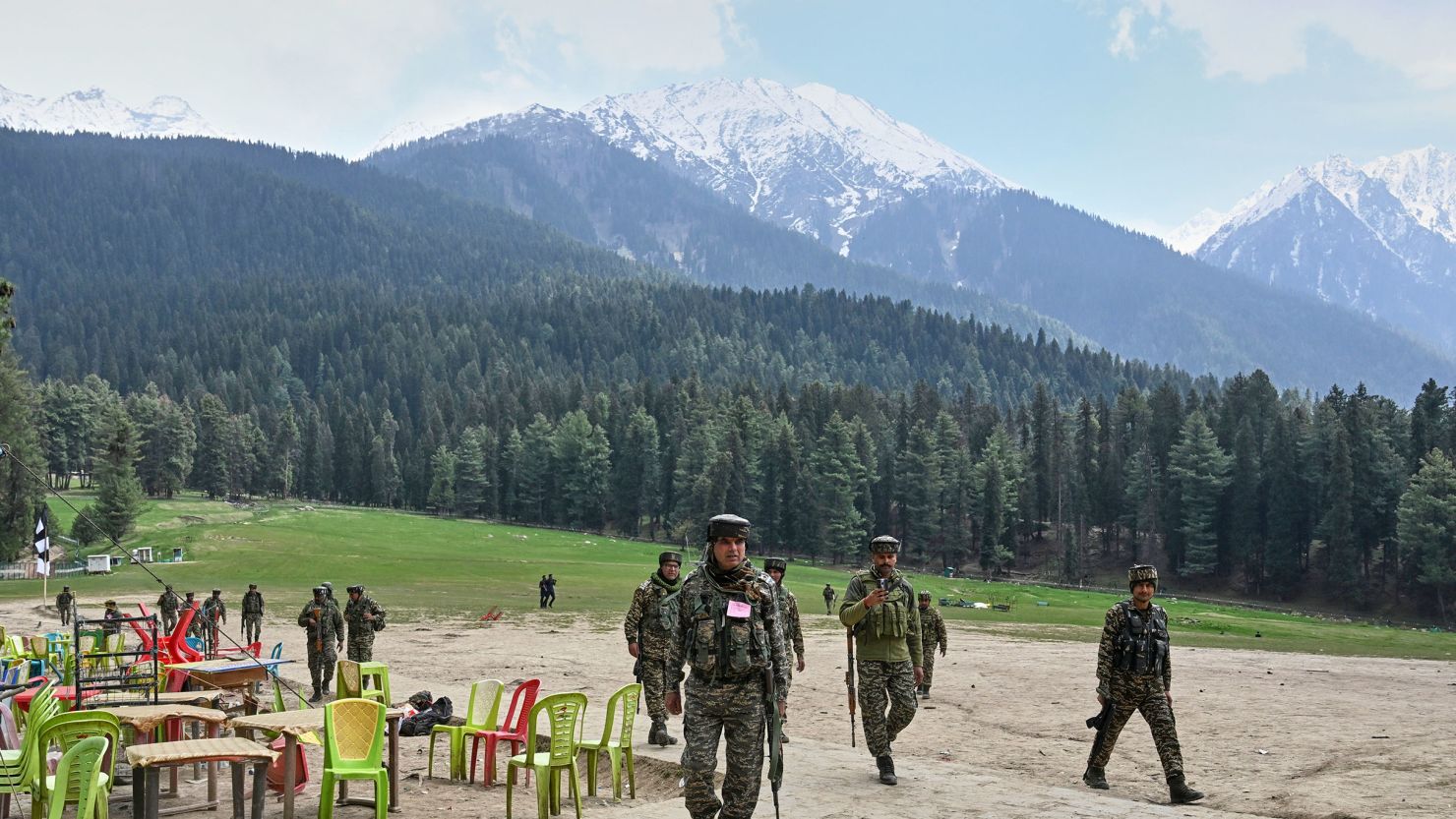
Source: CNN
Hassan Aslam Shad
One year on, the 2025 Pahalgam attack in Indian Illegally Occupied Jammu and Kashmir (IIOJK) still hangs over South Asia as an unanswered question that continues to shape events. On April 22, 2025, gunmen brutally assaulted tourists in Pahalgam, IIOJK, killing 26 civilians in a gruesome act of violence. The attack shocked global conscience and would have provoked anger and a demand for justice anywhere. In India, it caused both. But when grief turns too quickly into certainty, judgment can narrow and restraint can begin to erode.
What followed proved dangerous. India’s posture since the crisis, including its assertion that what it has described as Operation Sindoor remains paused rather than concluded, has cemented instability in India-Pakistan relations. As a result, South Asia has been pushed into uncertainty, with the spectre of war increasing. Within weeks, that posture contributed to a period of heightened military tensions, including exchanges between India and Pakistan from May 6 until May 10, a stark reminder of how quickly false assumptions can turn into escalation. This shift from tragedy to confrontation did not occur in isolation. Rather, it reflected a series of decisions taken before the facts were fully known.
The scale of the tragedy is not in dispute. The question is not whether India was entitled to anger, but whether it was entitled to act without first establishing a sufficient evidentiary basis in accordance with international law. That boundary carries real consequences because once it is crossed, escalation becomes easier to justify and far harder to control.
From the outset, India attributed the Pahalgam attack to alleged Pakistan-linked militant groups. Pakistan condemned the killings, denied involvement, and called for a joint investigation. That call was grounded in precedent. After the 2008 Mumbai attacks, both states engaged in limited cooperation despite deep mistrust. The process was imperfect, but it showed that engagement was possible even in moments of crisis. The post-Pahalgam attack offer from Pakistan carried the same possibility. It was a chance to test facts before fixing blame. India declined it. In doing so, it shut down the only credible mechanism through which competing claims could have been tested against evidence.
Consequently, the narrative hardened quickly. Public discourse shifted from grief to certainty. Pakistan was declared culpable. Television studios became courtrooms and verdicts were delivered without trial. This fuelled a climate of public fury that made de-escalation politically impossible and untenable. The result was a short but dangerous crisis between India and Pakistan that demonstrated how fragile strategic stability remains in South Asia. In that atmosphere, doubt was treated as weakness and the space for careful inquiry narrowed considerably.
This is where international law comes into the picture. Its discipline matters most at moments when pressure to act is at its highest. It is meant to slow states down when the instinct is to move quickly and decisively.
Under international law, the use of force across borders is not justified by accusation alone. The rules on state responsibility set a high bar for blaming a state for the actions of non-state groups and actors. That threshold exists to guard against premature conclusions and miscalculation.
The starting point is the famous Nicaragua v United States case. In that case, the Court established the requirement of proof that a state exercised effective control over the specific operation by an armed group in which the wrongful act occurred. This means control over the particular attack itself, not merely a general relationship with, or support for, the group. The Court held that general support or association with a group does not meet this requirement and that the connection must be tied directly to the attack itself and supported by evidence that shows direction or control by the state over that operation.
A second approach was laid down in the Prosecutor v Tadić case before the International Criminal Tribunal for the former Yugoslavia. This test is somewhat broader and establishes state responsibility where it exercises overall control, meaning a state is involved in organizing, coordinating, or supporting the group’s operations in a sustained and meaningful way. However, even this broader test requires more than political alignment or passive support. It demands evidence of a real role in the group’s operational framework. It should be noted, however, that this formulation emerges from ICTY jurisprudence and has not been adopted in the same form by the International Court of Justice. Even then, the threshold remains grounded in evidence and cannot rest on political narrative and hyperbole.
Put simply, both Nicaragua and Tadić point to the same basic idea, i.e., a state should not rely on accusation alone and must have some factual basis before using force.
Some international law scholars contend that, even if a state cannot prove another state was directly behind an attack, it may still act in self-defense under Article 51 of the United Nations Charter against non-state groups. This is especially argued where those groups operate from another country and that country is said to be unable or unwilling to stop them. This idea has become more common since 2001, but it remains debated and has not been clearly accepted by the International Court of Justice. Even those who support this view generally agree that it cannot be based on mere claims. At the very least, there must be some clear basis: there must have been a serious armed attack; the attackers must have been operating from the territory in question; and the state in that territory must have failed in a way that could engage its responsibility. Without these elements, claims of self-defense risk replacing proof rather than responding to it.
One year after Pahalgam, that threshold remains unmet by India in the public domain. While India accentuated links between the attackers and Pakistan-based organizations, it has not presented a shred of evidence that meets either the Nicaragua or the Tadić tests. Without a clear proof of control, the actions of a non-state group or actor cannot be pinned on Pakistan. Without that link, the legal ground for cross-border force is seriously weakened in law. What India did was to fill that void on the basis of assumption, and once assumption takes hold, it begins to shape policy in ways that are difficult to reverse.
Equally troubling is what did not happen. International law does not impose a strict obligation, but it does, as a matter of sound practice, encourage cooperation between states when responsibility is unclear. Pakistan’s call for a joint investigation followed that logic. India’s refusal avoided one available process that could have confirmed its claims or exposed their limits. A joint investigation is not a procedural nicety but a disciplined framework for collecting and verifying evidence in a way that carries credibility beyond national positions. It allows facts to be established through a shared process rather than asserted unilaterally. When that process is rejected, the result is not just a lack of clarity but a reduction in confidence in the conclusions that follow. It also removes any neutral basis on which escalation can be restrained, leaving each side to act on its own narrative.
There are international precedents for state cooperation. After the downing of Malaysia Airlines Flight 17 in 2014, a joint investigation team was formed to gather and assess evidence. Similarly, after the 1988 Lockerbie bombing, investigations were launched, leading to the trial and conviction of the accused. In both cases, states chose cooperation over assumption when the stakes were high.
Instead, what followed Pahalgam was attribution before investigation and retaliation before proof. Sadly, this establishes a dangerous pattern and signals that India prefers that evidentiary standards be bypassed in favour of political expediency. In a region already marred by deep mistrust between India and Pakistan, that signal lowers the threshold for future confrontations.
If Pahalgam revealed anything, it is this: when law is replaced by assumption, power takes its place. And power without proof does not just risk escalation; it invites it. What is at stake extends beyond one incident and concerns the standard by which the next crisis between India and Pakistan will be judged and handled. What failed after Pahalgam was not only the search for evidence but the willingness to wait for it. That failure now casts a longer shadow than the attack itself, because it reshapes how future crises between India and Pakistan will unfold. If proof is no longer the starting point, restraint has no anchor and escalation has no brake. In South Asia, where the margin for error between India and Pakistan is already thin, that is not only risky but also sets a dangerous precedent for the next miscalculation, which may leave no space for correction.
Hassan Aslam Shad is an international law practitioner and a geopolitical analyst. He is a graduate of Harvard Law School.
The views expressed in this article are the author’s own, and they do not necessarily represent those of Pakistan Politico.
About the Author